Cambridge Fine Art Gallery
Among the many British marine painters of the late 19th and early 20th centuries, William Anslow Thornley stands out for his ability to capture the quiet lyricism of coastal life. His paintings are not grandiose naval dramas or storm‑tossed epics; instead, they offer a gentler, more intimate view of Britain’s harbours, estuaries, and seaside towns. Thornley’s work is defined by atmosphere, soft light, shifting tides, and the subtle interplay between sky and water.
At Cambridge Fine Art Gallery, we are delighted to present a curated selection of Thornley’s paintings, each one demonstrating his remarkable sensitivity to mood and place. Below, we explore seven works that beautifully illustrate his artistic voice.
The Lower Thames
Cambridge Fine Art Gallery
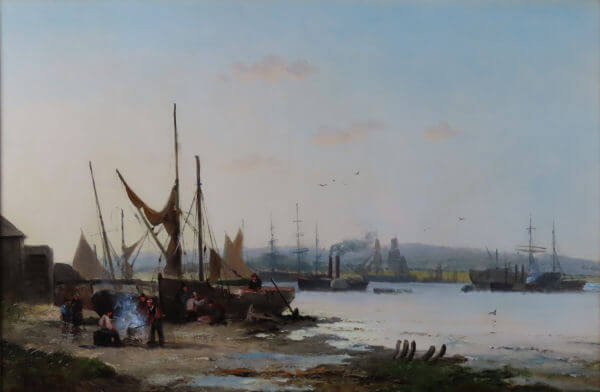
In The Lower Thames, Thornley turns his attention to one of Britain’s most historically significant waterways. Rather than emphasising industry or movement, he offers a tranquil, contemplative scene. The moored vessels sit quietly on still water, their reflections shimmering in muted tones of blue and grey. Thornley’s restrained palette and delicate brushwork create a sense of calm that feels almost meditative. It is a painting that rewards slow looking, revealing new subtleties with each moment of attention.
Cromer, Norfolk
With Cromer, Norfolk, Thornley shifts to the open coastline, capturing the charm of one of East Anglia’s most beloved seaside towns. The composition balances the vastness of sea and sky with the human scale of fishing boats and shoreline activity. Gentle light washes across the scene, softening the horizon and lending the work a nostalgic warmth. Thornley’s ability to evoke the character of a place its atmosphere, its rhythm, its quiet beauty is on full display here.
Misty Morning, Whitby
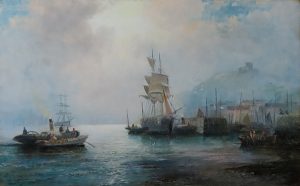
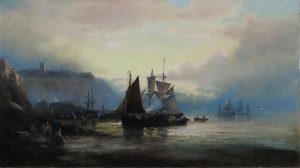
Misty Morning, Whitby is a masterclass in tonal harmony. Thornley embraces a subdued palette to convey the hush of an early coastal morning, where mist blurs the boundary between sea and sky. The fishing boats emerge softly from the haze, their forms suggested rather than sharply defined. This atmospheric subtlety is one of Thornley’s greatest strengths: he paints not just what the eye sees, but what the moment feels like. The result is a work that is both evocative and deeply peaceful.
A Breezy Day off Hastings
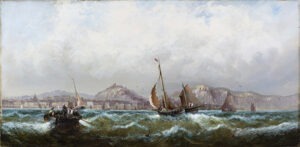
In A Breezy Day off Hastings, Thornley introduces a livelier energy. The wind fills the sails, the water ripples with movement, and the sky carries a sense of shifting weather. Yet even here, Thornley avoids drama in favour of balance and harmony. The scene feels fresh and invigorating without losing the quiet elegance that defines his style. It is a wonderful example of how he captures the character of the English coast in all its moods.
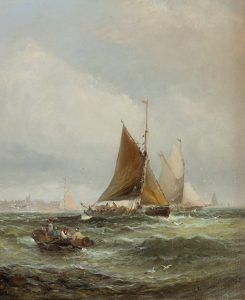
A Medway View
Cambridge Fine Art Gallery
A Medway View showcases Thornley’s gift for capturing the character of England’s working waterways. The River Medway, long associated with maritime trade and shipbuilding, becomes in Thornley’s hands a place of gentle beauty. Soft light glances off the water, illuminating moored vessels and distant riverbanks. The composition feels grounded and authentic, offering a glimpse into the everyday rhythms of river life.
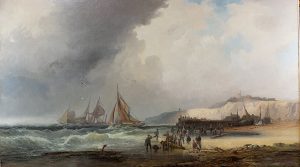
A Busy Beach View
Cambridge Fine Art Gallery
In A Busy Beach View, Thornley turns to the social life of the seaside. This painting is filled with movement and human presence — figures strolling, boats preparing to launch, and the lively bustle of a coastal community. Yet Thornley maintains his characteristic softness of palette and atmosphere, ensuring the scene remains harmonious rather than chaotic. It’s a charming reminder of the seaside’s enduring appeal.
Southend

Cambridge Fine Art Gallery
With Southend, Thornley captures the unique character of one of England’s most recognisable coastal towns. The scene blends gentle maritime activity with the expansive openness of the Thames Estuary. Thornley’s handling of light is particularly striking here: soft coastal haze diffuses the sky, while subtle reflections shimmer across the water’s surface. The painting conveys both the liveliness of a popular seaside destination and the quiet poetry of the shoreline beyond. It is a beautifully balanced work that highlights Thornley’s ability to evoke place with sensitivity and grace.
William Anslow Thornley: The Coastal Painter Who Captured Britain’s Shores
William Anslow Thornley, born in Preston, Lancashire in September 1847, became one of the most admired painters of coastal marine scenes in the late 19th and early 20th centuries. His early years took him from Preston to the Birmingham area, but by the late 1870s he had settled in Gravesend. There, with a studio overlooking the River Medway near Rochester, he found the perfect vantage point for the atmospheric seascapes that would define his career.
A Man of Many Spellings
Thornley’s name has long been a small mystery in the art world. Born Thornbery, he signed his works under several variations: Thornley, Thornely, Thornberry, and Thornbury. This wasn’t unusual for artists of the period, who sometimes used alternate spellings to supply different galleries while maintaining a sense of exclusivity.
Exhibitions and Artistic Style
From 1883 onward, Thornley exhibited widely, including at the Royal Society of British Artists in London, the Royal Cambrian Academy in Conway, and the Royal Hibernian Academy in Dublin. His paintings are instantly recognisable for their balanced compositions: sweeping coastlines, lively seas, and carefully placed figures and boats that bring each scene to life.
Thornley had a gift for atmosphere. Whether he was capturing the glow of a golden sunset or the breezy bustle of an everyday harbour, his strong, warm palette kept his marine scenes vibrant rather than cold, a quality that sets him apart from many of his contemporaries.
A Painter of Britain’s Shores
Although he travelled widely across the British Isles and even painted coastal views in Holland and France, Thornley is especially associated with England’s East Coast. Kent, East Anglia, Lincolnshire, and Yorkshire all feature prominently in his work. He was drawn to harbours, cliffs, estuaries, and the working life of the coast, with the Medway estuary near his home becoming one of his favourite subjects. He also painted along the south coast, with St Michael’s Mount in Cornwall appearing in several of his pieces.
Legacy and Collections
Thornley’s paintings have become increasingly collectable, admired for their warmth, detail, and sense of place. Today, his works can be found in notable collections including the Harris Museum in Preston, Southampton Art Gallery, Sunderland Museum, Dumfries and Galloway Museum, and the Jersey Museum.
He was survived by two children: his son Howard, and his daughter Lily Maria (1880–1964), who followed in his footsteps as a maritime painter and worked as her father’s studio assistant.
A Legacy of Light and Stillness
William Anslow Thornley’s paintings endure because they offer something timeless: a sense of place, atmosphere, and tranquillity. His works invite viewers to pause, breathe, and appreciate the understated beauty of Britain’s coastal landscapes. For collectors, Thornley represents both artistic refinement and emotional resonance, qualities that make his paintings as compelling today as they were over a century ago.
At Cambridge Fine Art Gallery, we are proud to showcase these exceptional works. Whether you are discovering Thornley for the first time or deepening an existing appreciation, his paintings offer a quiet, enduring pleasure.